Filled with Expectation

Meditation on Luke 3:7–18

Third Sunday of Advent

The Presbyterian Church, Coshocton

Pastor Karen Crawford

Livestream of the service: https://fb.watch/9S9N3jS_8A/

Bulletin:

Monsieur Charles Blondin became the first person to cross the Niagara Falls on a tightrope in the summer of 1859.  This was something the French acrobat would go on to do hundreds of times, always without a net! When word got out that he would be crossing the Niagara on a 1,300-foot rope, two inches in diameter, without a net, gamblers began to take bets on whether he would plunge to a watery death.

“On the morning of June 30, 1859, about 25,000 thrill-seekers arrived by train and steamer to gather on the American or Canadian side of the falls for a view of Blondin. He was dressed in pink tights and held a balancing pole of ash, 26 feet long and weighing 50 pounds. Smithsonian reports,“Both banks grew ‘fairly black’ with swarms of spectators, among them statesmen, judges, clerics, generals, members of Congress, capitalists, artists, newspaper editors, professors, debutantes, salesmen and hucksters. Vendors hawked everything from lemonade to whiskey.”

 “Children clung to their mothers’ legs; women peeked from behind their parasols. Several onlookers fainted. About a third of the way across, Blondin shocked the crowd by sitting down on his cable and calling for the Maid of the Mist, the famed tourist vessel, to anchor momentarily beneath him. He cast down a line and hauled up a bottle of wine. He drank and started off again, breaking into a run after he passed the sagging center. While the band played ‘Home, Sweet Home,’ Blondin reached Canada.”

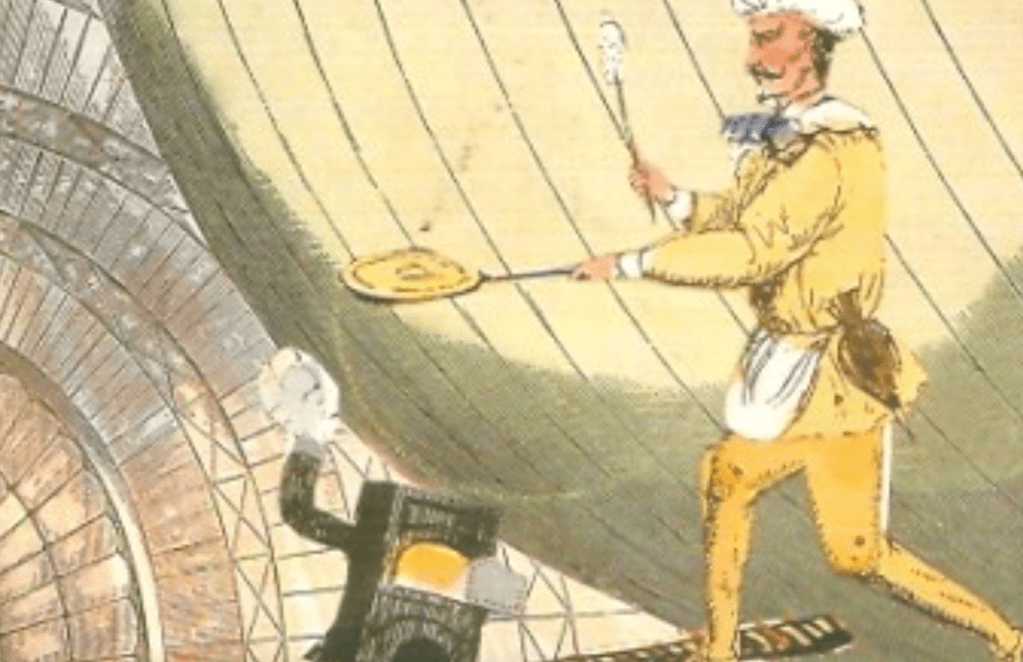
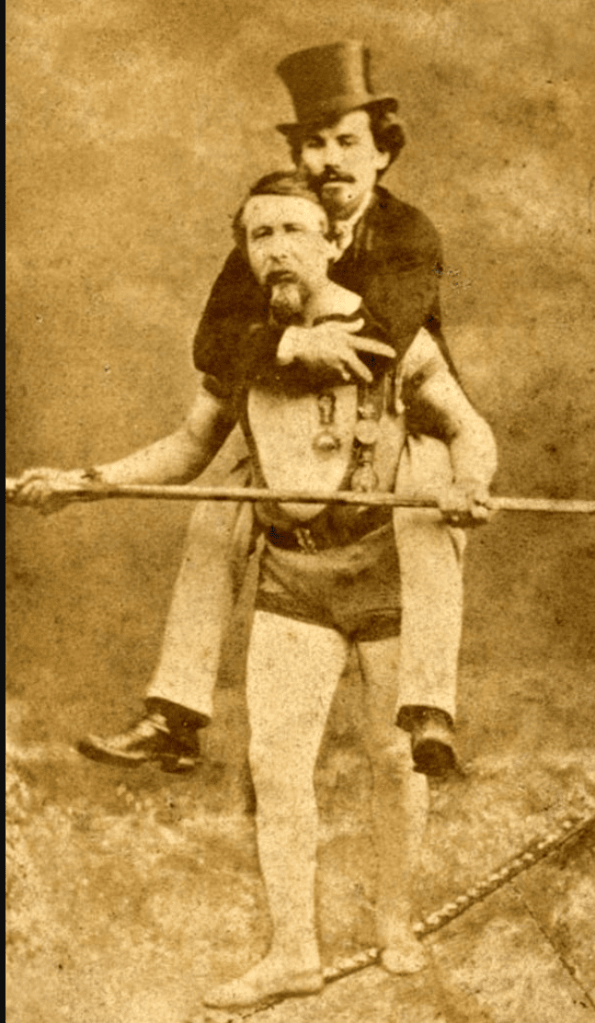
On another crossing, he famously “carried a stove and utensils on his back,  walked to the center of the cable, started a fire and cooked an omelet.” Another time, he “walked backward to Canada and returned to the U.S. pushing a wheelbarrow. Two weeks later, he somersaulted and backflipped his way across, occasionally pausing to dangle from the cable by one hand. Shortly after that he made another crossing, and, after a brief rest, appeared on the Canadian end of the cable  with (his manager) Harry Colcord clinging to his back.

Blondin gave his manager the following instructions:  “Look up, Harry.… you are no longer Colcord, you are Blondin. Until I clear this place be a part of me, mind, body, and soul. If I sway, sway with me. Do not attempt to do any balancing yourself. If you do, we will both go to our death.”

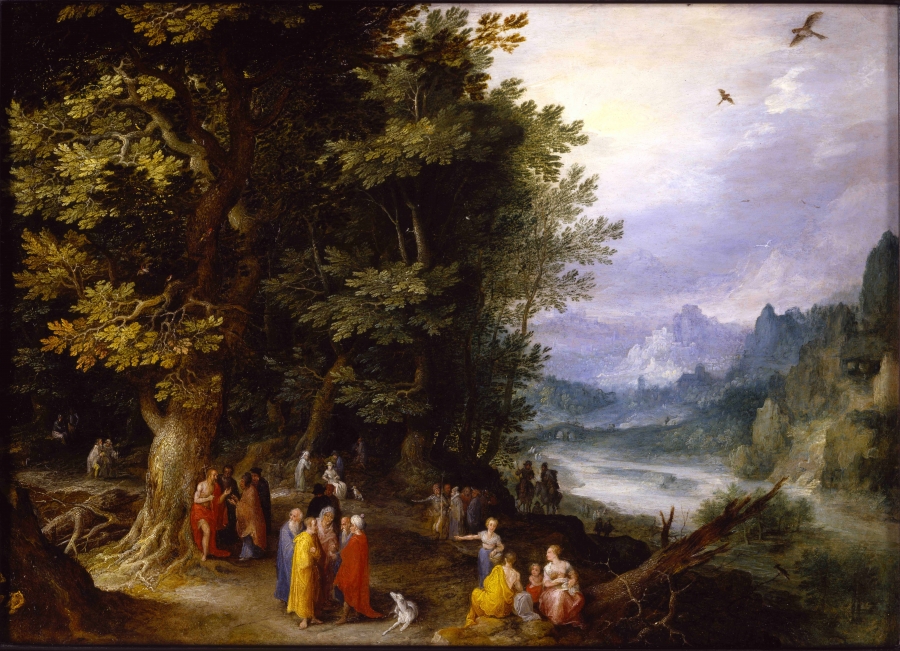
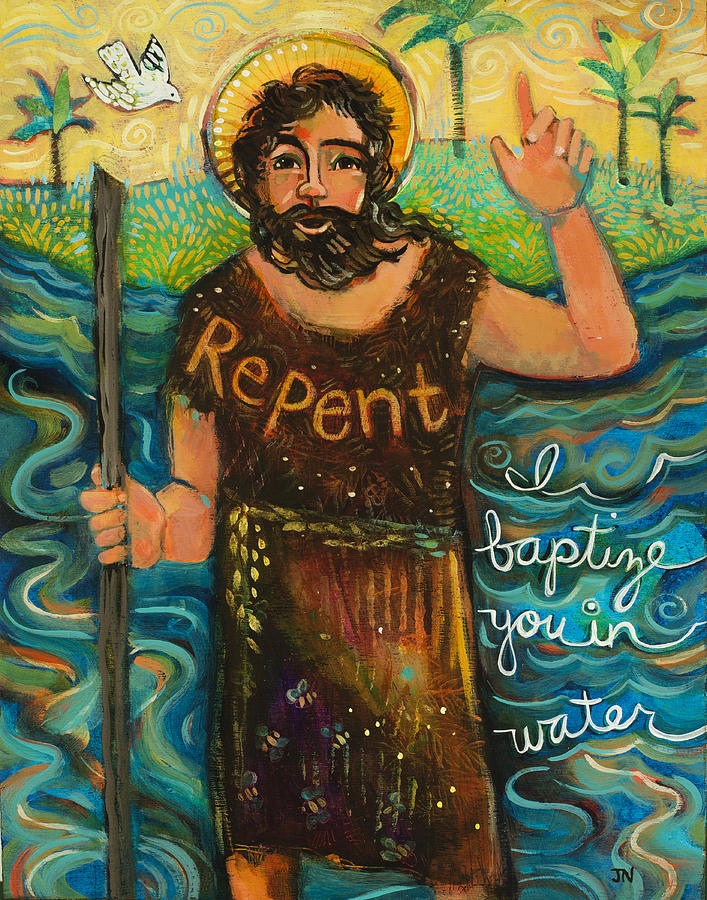
The crowds are gathered at the Jordan River  with John the Baptist in our gospel lesson in Luke today. They come from the villages and the cities. They are curious about the charismatic preacher dressed in camel’s hair. They hang on his every word—for they have never heard preaching quite like this. He brings hope to those who long to be set free from the oppression of the Roman Empire, which controls every aspect of their life, including their religion.

But others come, too. Those of wealth, status, and power. The oppressors. Scoffers come to see what all the fuss is about so they can go home and tell everyone what a fraud this man John is, the errant son of Zechariah and Elizabeth. Look at this man who so foolishly chose a wilderness pulpit over a nice, lucrative priestly career as a puppet of the Empire.

And they are afraid of John and his popularity, afraid of what the Empire might do to them because of John. These are the ones John is talking to when he says it’s not enough to be born into the faith—to have the right people on your family tree. God expects us to reveal who we are and what we believe by how we live.

John says,  “You brood of vipers! Who warned you to flee from the wrath to come? Bear fruits worthy of repentance.  (And) do not begin to say to yourselves, ‘We have Abraham as our ancestor’; for I tell you, God is able from these stones to raise up children to Abraham.  Even now the ax is lying at the root of the trees; every tree therefore that does not bear good fruit is cut down and thrown into the fire.”

John provides a vision of the Kingdom of God ushered in by the more powerful One who is coming after him! It’s nothing like any kingdom of this world.  For in God’s Kingdom, love reigns! When the crowd responds to John’s preaching,  “What, then, should we do?” John says,  “Whoever has two coats must share with anyone who has none; and whoever has food must do likewise.” 

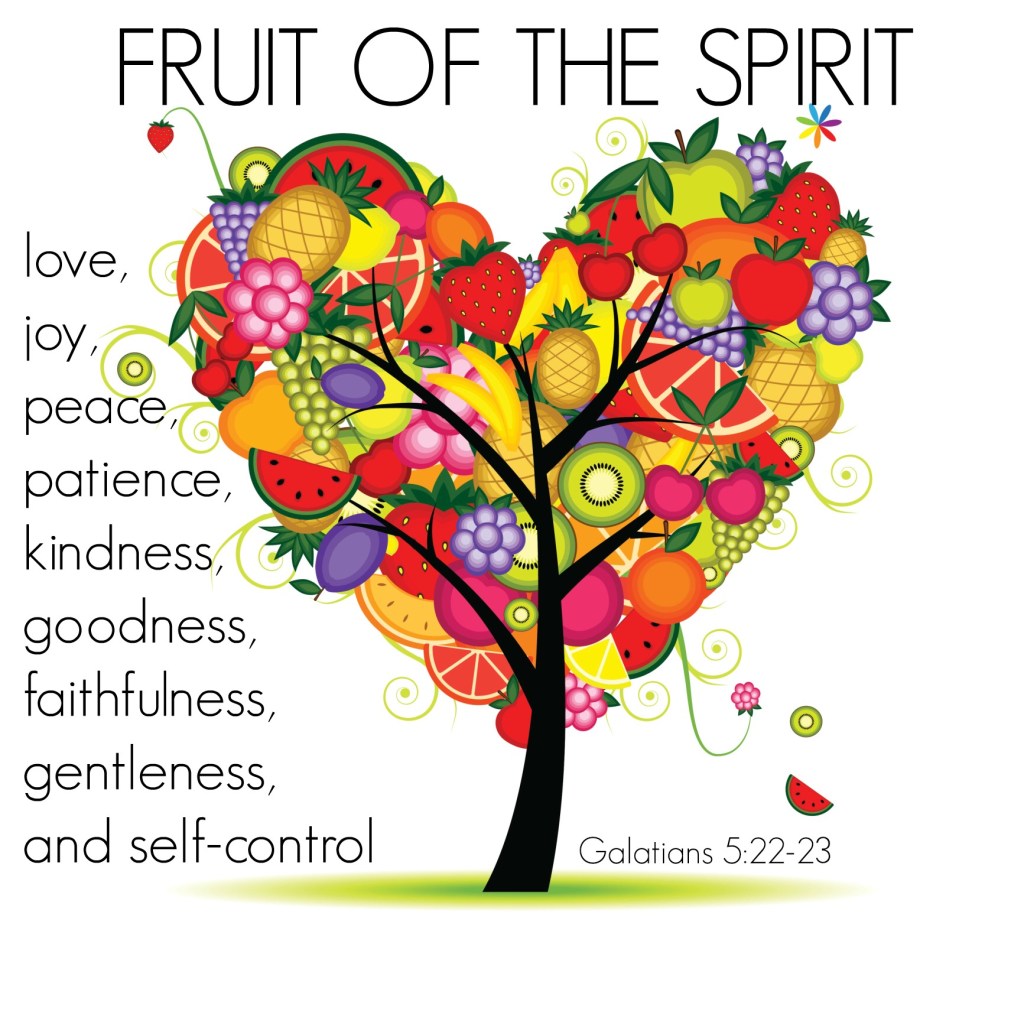
Think, for a minute, how dangerous this mob could be if John had incited them to turn against their corrupt leaders and seek revenge. That’s what we often see in this world! Hate and revenge! But that’s not what the Holy Spirit does.  The fruit of the Spirit is love, joy, peace, patience, kindness, faithfulness, gentleness and self-control.  Hearts are touched! Lives are transformed!

What strikes me in this passage is that the peaceable Kingdom is BIG enough and God’s grace is WIDE ENOUGH to include even the “worst” sinners of the community in John’s day, if there are “worse” sinners. And if it’s BIG enough and Wide enough for the sinners of John’s day, it’s big enough and wide enough for all sinners today. The Kingdom of God isn’t getting smaller. It’s GROWING!

Luke says,  “Even tax collectors came to be baptized,” which would have sent shockwaves through the crowd.  Tax collectors had the reputation in the Roman world as “meddlers, crooked, and deceitful.” (Joel B. Green). John doesn’t “take aim at the tax system itself, but instead concerns himself with the behavior of particular tax collectors.” In other words, they don’t have to stop working as tax collectors to be faithful in the Kingdom of God. They have to change their wrong attitudes and sinful behaviors.  John tells them, “Collect no more than the amount prescribed” for them.

And then there are soldiers, who use violence, threats, and intimidation to terrorize the people.  Now they want to change! They ask John what they should do. Notice he doesn’t say, “Stop being a soldier and come live with me in the wilderness.” They can still be soldiers and be faithful! He tells them to change their attitude and behavior. He says,  “Do not extort money from anyone by threats or false accusation, and be satisfied with your wages.”

This work of the Spirit  through John’s proclamation and the baptism of repentance stirs the people to want to be different. They want to be ready! For Christ is coming to gather the wheat into the granary and burn up the chaff, bringing with him the just and peaceful Reign of God.

 The people are filled with expectation. They wonder about John and his words. Is he a prophet? Is he Elijah? Has the Messiah finally come?

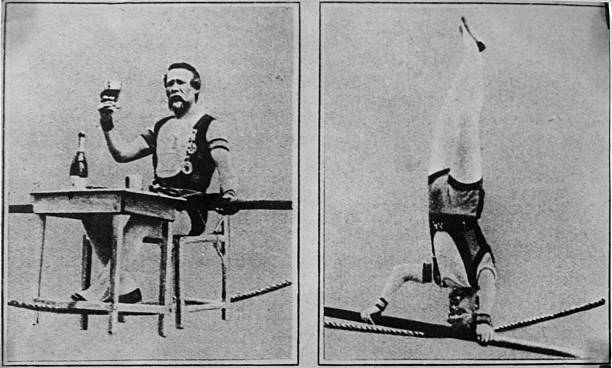
French acrobat and tightrope-walker Charles Blondin (1824 – 1897), real name Jean Francois Gravelet, on two of many crossings of the Niagara River, circa 1860. In the left frame Blondin sits down midway to eat an omelette and drink wine at a table, in the right frame he balances on his head. (Photo by Hulton Archive/Getty Images)

“(Charles) Blondin performed in China, Japan, Australia, India and throughout Europe.  He soured on America in 1888 when he was forbidden to perform in Central Park and had to settle instead for St. George in Staten Island. Although he was then 65 years old, he carried his son and another man on his back and made another omelet for the crowd. By the time he gave his final performance, in 1896, it was estimated that Blondin had crossed Niagara Falls 300 times and walked more than 10,000 miles on his rope.” (Smithsonian) All without life insurance. He always joked that no one would take the risk.

Friends, can you imagine that you are at the Niagara Falls with Blondin in the 1800s—and you are riding on the back  of the French acrobat, like his manager did, without a net below you? Blondin is saying to you that for this journey, you mustn’t imagine yourself as a separate being.  No longer yourself, you are Blondin—body, mind and soul. “If I sway, sway with me,” he says. “Do not attempt to do any balancing yourself.”

And this is how it is with the Spirit of Christ living in us.  For the one who claimed us in our baptism dwells with us forever and wants us to rely on Him! This is how we can change the world, by changing ourselves. Each day, when we wake up and clothe ourselves with Him, we have a new beginning—another opportunity to become less us and more Him. As Paul says in Galatians (2:20),  “I have been crucified with Christ and I no longer live, but Christ lives in me. The life I now live in the body, I live by faith in the Son of God, who loved me and gave himself for me.”

Friends, let us also imagine ourselves in the crowd gathered at the Jordan with John in the wilderness.  Whatever our reason for coming—faith, wonder, doubt, curiosity, longing for change or to be changed, or just entertainment, as those who came to see Blondin cross the Niagara, all are welcome!

 Come and see what the Lord is doing. The Reign of God is BIG enough for all sinners. God’s grace is wide enough for all. For the one to whom we belong is the One who died to set us free from sin and death.  

 Come and be made new! For Christ is coming again in power with his winnowing fork—to gather the wheat into the granary and burn up the chaff.

 On this Third Sunday of Advent, let the good news of the Messiah and the God of hope fill you with all joy and peace in believing.  And like the crowd who gathered at the Jordan long ago, may your hearing of the good news move you to LIVE IT and SHARE it.

 May you be filled with expectation!

Let us pray.

Holy One, thank you for the words of the prophets, such as John the Baptist and his godly example. Prepare us, Lord, for your coming—for when you gather us like wheat in a granary. Touch our hearts by your Spirit. Transform our lives so we are empowered to live now as you desire us to live, following in your perfect will, walking in the way of peace. Lead us to be more like your Son and bear good fruits of repentance, revealing our hope and joy, grace and love, humility and generosity, kindness and compassion. In the name of our Triune God we pray. Amen.

Go Wild!

Meditation on Luke 3:1-6 for the Second Sunday of Advent

The Presbyterian Church, Coshocton, OH

Pastor Karen Crawford

Dec. 5, 2021

Link to our bulletin:

Link to a recording of our live-streamed service: https://fb.watch/9I-O0RdrmY/

Are you ready for Christmas? Anybody in here ready for Christmas? It’s not a trick question, really. All of us have things we do as we prepare for our celebration of Christ’s birth. We all have meaningful traditions throughout this season of light.

    A Christmas tree has always been important to me. How bout you? I have seen your photos of Christmas tree hunting and decorating on Facebook!

I am hoping we will decorate our tree and home this week.

   Other important rituals. Christmas shopping? Anybody shop on Black Friday? You’re brave. Christmas cards? I always write cards—lots of them. But I never get them sent out early.

    Baking? When my children were little, I used to make about 7 or more different kinds of Christmas cookies.  My mixer would be working overtime. Drop, shape, and bar cookies, the roll out/cookie cutter kind—sugar and gingerbread people.

    Gatherings and special meals with family and friends.  Exchanging gifts. Christmas caroling, visiting elderly members and neighbors. Worship on Christmas Eve—lighting candles, ringing bells, singing “Silent Night.”  These traditions are even more special to us this year, perhaps, after not being able to gather last year because of the pandemic.

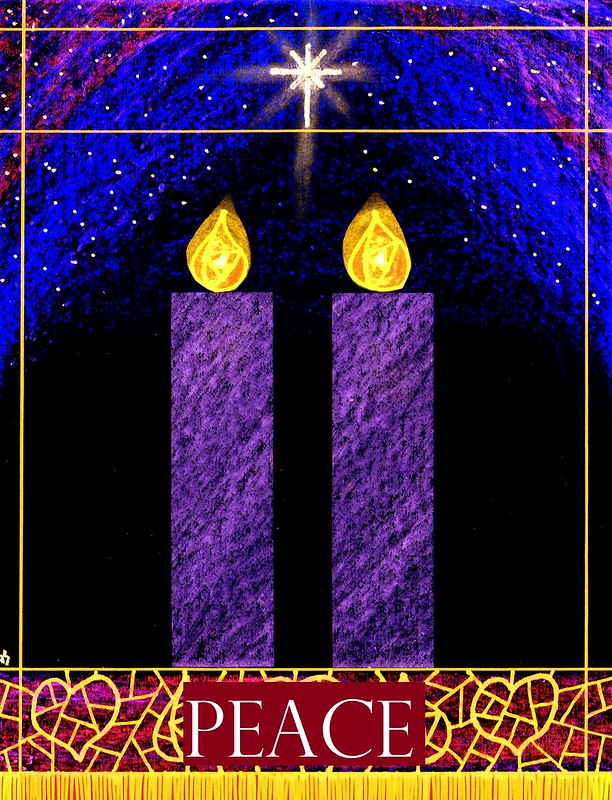
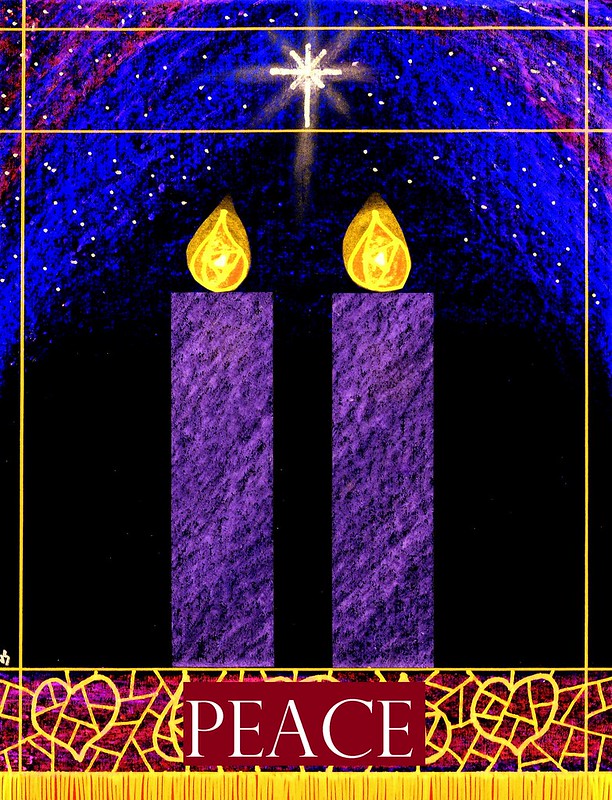
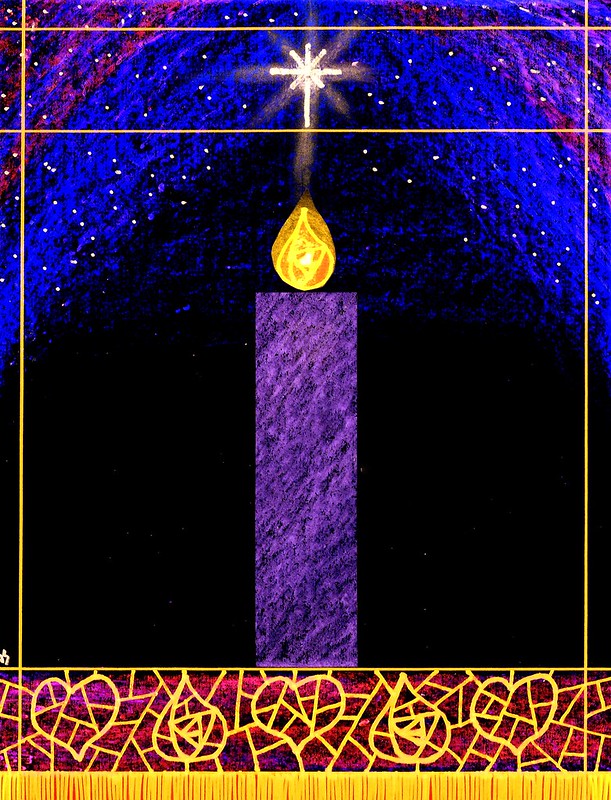
     But on this Second Sunday in Advent,  as we light candles for hope and peace and anticipate our Lord’s return, the gospel urges us to be open to a new move of the Spirit. This is the time for boldness and risk for we who are stewards of God’s grace and love, called to be Christ’s Body for the world.

      “Prepare the way of the Lord!” is the Baptist’s timeless cry to us from the wild place.

        All flesh shall soon see the salvation of God.

***    

    One thing I like best about John the Baptist is that he is not afraid to be different. He doesn’t worry what other people think of him!  He is a truthteller and will anger people in high places because of it. He’s the last of the Old Testament prophets and the first of the New Covenant prophets. He points the way to the One who is more powerful than He, the One who baptizes with the Holy Spirit and fire. When he is in prison, he will send his followers to ask Jesus in Luke 7:19,  “Are you the one who is to come, or should we expect someone else?”

    John is the fulfillment of the angel Gabriel’s prophecy to Zechariah the priest in Luke chapter 1. Gabriel tells Zechariah that his wife, Elizabeth, who had been unable to have a child, would give birth to a son. They will name him John.  “You will have joy and gladness, and many will rejoice at his birth,” the angel says, “for he will be great in the sight of the Lord.” The child must not drink wine or strong drink as he will be filled with the Holy Spirit even before his birth.  “He will turn many of the people of Israel to the Lord this God,” the angel goes on. “With the spirit and power of Elijah he will go before him to turn the hearts of parents to their children and the disobedient to the wisdom of the righteous, to make ready a people prepared for the Lord.”

    John will likely hear this story retold again and again in his childhood, including   the part about his father not believing the angel and being rendered speechless for his lack of faith until after the prophecy of John’s birth has come true.

   But then, Zechariah will burst out in a song of praise and prophecy of his son:

 76 And you, child, will be called the prophet of the Most High;
    for you will go before the Lord to prepare his ways,
77 to give knowledge of salvation to his people
    by the forgiveness of their sins.
78 By the tender mercy of our God,
    the dawn from on high will break upon us,
79 to give light to those who sit in darkness and in the shadow of death,
    to guide our feet into the way of peace.”

    Gabriel’s prophecy to Zechariah of John’s ministry is fulfilled today in our reading in Luke chapter 3. The movement of God finds the Baptizer in the wilderness, traveling the region of the Jordan River.  

This will stir memories for Jewish followers of Christ of the Israelites’ exile with Moses in the wilderness and of the place where they crossed with Joshua into the Promised Land. Now, John is inviting God’s people to come back not to the corrupt institution of religion of his time—the one he turned his back on, though he had a hereditary claim to the priesthood—but out to the middle of nowhere,  away from the world of foreign rule by emperors and puppet rulers like Pontius Pilate, governor of Judea, and Herod, ruler of Galilee. People from all walks of life are drawn to this wild place and the preacher wearing camel’s hair and eating locusts and honey. Away from the noise, distractions and distress of their daily lives is where the people find themselves and become a better version of themselves, rediscovering their identity as the beloved people of God and their purpose—to love and serve Him. Their hearts are prepared for a new beginning with God, not through the law or by priestly sacrifice but by grace, with John’s baptism of repentance for the forgiveness of sins. This will be the first step in the societal “road construction” of which Isaiah prophesied—the valleys being filled, the mountains and hills being made low, the crooked paths being made straight and the rough ways made smooth.  

     We all need a God-filled place like the wilderness in John’s time, especially in this season of Advent, when the world wants to keep us busy and distracted or longing for our pre-pandemic existence. We need a space that is just right for being ourselves with God and other followers of Christ. Away from the noise, distractions and distress of our daily lives is where we find ourselves and become a better version of ourselves, and remember our identity as the Redeemed, claimed by Christ in our baptisms. We all need a place where we are renewed in our purpose—to love and serve Him. And our hearts are prepared for a new beginning with God.

    Friends, what if that space for us is right here—in this place? What if this is our wilderness retreat, where we come to know and rely on the Lord, trust in His Word and cling to His love? Then, nourished by Spirit, Word and Sacrament, we are sent out—together—as Christ’s Body for the world.

   We gathered for our second youth and young adult service in the chapel this morning at 9. I feel such hope, joy, and peace when I am with our young people in the informal, intimate setting, singing songs of praise and studying God’s Word. I pray that those who participate in our early service will feel comfortable in that space and able to be completely themselves, sharing without worry of what people will think of them. We intentionally made sure the service would be different than our 10:30 worship, so that it would be something just for them, that they could call their own, and would evolve as they make it more their own.

    Before Session and I decided to start this new, experimental service on the first Sunday of Advent, I asked myself, “What are you thinking—starting a second service during the busiest season of the church year?” Would there be a better time for this?  Immediately, the answer came, “What could be a better time than Advent—as we wait in hope for the coming of the Lord?”

   This is the time not just for warm, fuzzy traditions and rituals, but for boldness and risk for we who are stewards of God’s grace and love.

    “Prepare the way of the Lord!” is the Baptist’s timeless cry from the wild place.

     For all flesh shall soon see the salvation of God.

 Let us pray. Holy One, we hear the voice crying in the wilderness and we, with all our hearts and minds, respond now eagerly. Prepare us, Lord, for your coming, and help us to do the road construction that is needed in us and our society to prepare for your return—the filling in of the valleys, the making low of mountains and hills, the straightening of our crooked paths and the smoothing of our rough ways. Thank you for your prophets that weren’t afraid to be truth tellers and call us back to live loving and faithful lives in obedience to your Word. Come, Lord Jesus. Come quickly now. We long for the day when all flesh will see your salvation. In the name of our Emanuel we pray. Amen.

Your Redemption is Drawing Near

Meditation on Luke 21:25–36

First Sunday in Advent

The Presbyterian Church, Coshocton, OH

Pastor Karen Crawford

Link to live-streamed service with messages for children and adults:

https://fb.watch/9zA7Y-jtpV/

Link to bulletin:

      On this first Sunday in Advent, our readings speak of the growing darkness and chaos of our world living in these in-between times. We light a candle on the Advent wreath for our hope in things to come and in the Spirit that is with us now. We are waiting for the Coming of the Lord, not as a humble baby whom we celebrate at Christmas, but in power and glory, to reign as our King of kings. We are invited to look for signs in the sky—the sun, moon, and stars—and on earth, distress among the nations.

      Jesus has talked about other signs earlier in Luke 21—wars and insurrections, earthquakes and famines, plagues and persecution of believers. He urges us to pray for strength, for all these things will help grow the Kingdom because they will provide opportunities for us to testify to our faith, to shine His light in the darkness.

      I ran across the inspiring story of one of God’s faithful servants this week.

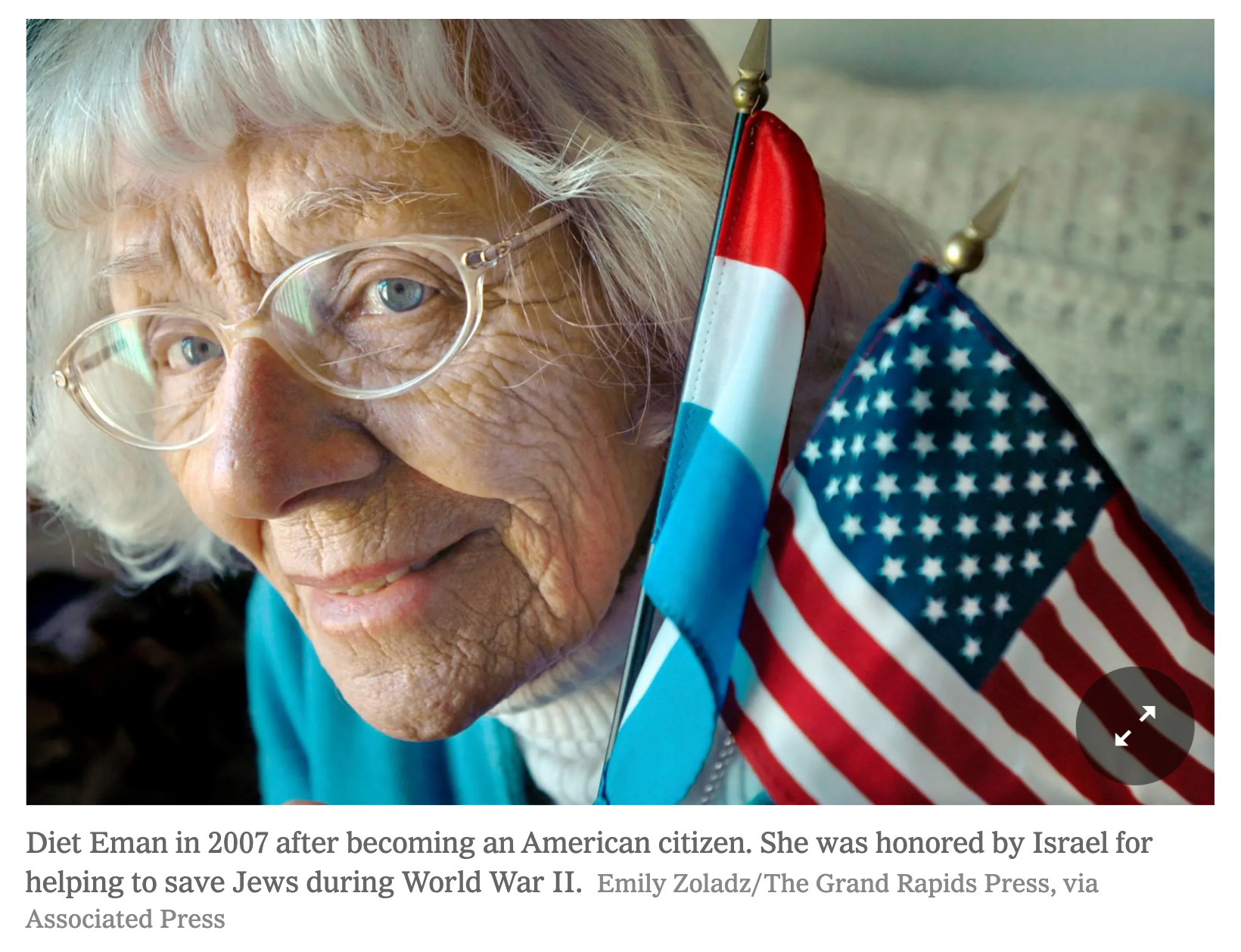
      Diet Eman was an “ordinary, shy woman” in the Netherlands in 1940, when the Germans invaded. She would later write, “When there is danger on your doorstep, you want to act almost like an ostrich burying its head in the sand.”

     “Yet Diet felt God calling her to resist the German oppressors,” writes Alyson Kieda (Our Daily Bread, Nov. 26). “This unassuming young woman became a warrior for God.”

     Diet’s NY Times obituary says that for 50 years, she remained silent about her role with the Dutch Resistance in World War II.  She moved to America after the war to escape her past and the memories of “friends and families lost, of unspeakable barbarism, of spineless collaboration, (and) of the moments her religious faith was tested to its very limit.”

     She became a nurse, learned Spanish, worked for Shell Oil in Venezuela, married an American engineer, divorced and moved to Michigan, where she worked for an export company.

       It wasn’t until 1978, after she heard fellow Dutch Resistance fighter Corrie ten Boom speak in her Michigan hometown that she began to think that it was time to speak—that she had an obligation to reveal her story about saving Jews, ferrying Allied pilots to safety and escaping the Gestapo.

        Then she met Professor James C. Shapp of Dordt College at a conference on suffering and survival in 1990. He persuaded her to write a memoir with his help, the 1994 Things We Couldn’t Say.

       Her story is also included with five other Dutch Resistance survivors in a 2007 documentary, The Reckoning.

       The tomboy daughter of an interior decorator grew up in the Dutch city of The Hague. When she was 9—in 1929, a severe depression hit the Netherlands, just as it did the United States. People no longer had money to buy wallpaper, lace curtains or drapes or have their furniture upholstered, so the family’s income melted away.

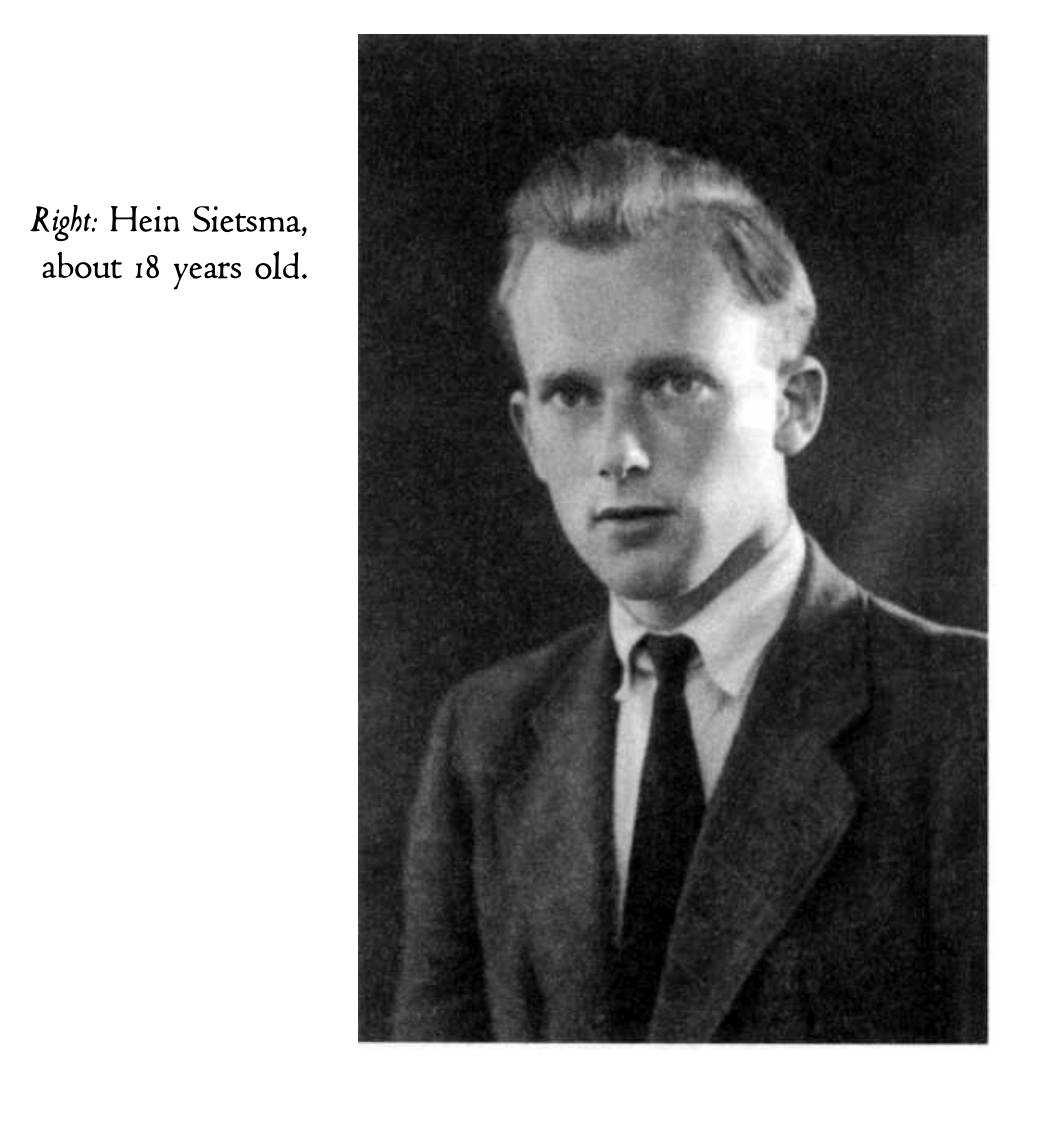
        In 1937 when she was 17, her family took in a young boarder for additional income. Eighteen-year-old Hein Sietsma worked at Shell Oil.  

He became part of the family, even attending church with Diet and her family. Hein was immediately interested in her and asked her mother how he might win her over.  She thought he was boring. They went on bike rides and he grilled her with questions. She preferred climbing trees with her friends. She changed her mind about him after he moved out a year later and was drafted into the Dutch military service. She missed him. He wrote to her and asked to see her when he was home on leave. She agreed and during those visits, her heart beat wildly; she realized she was in love with him.

         When she was 20 in May 1940 and still living with her parents and bicycling to work at a bank, the Germans invaded the Netherlands. Diet later wrote, “This happened only hours after Hitler had assured us that we in the Netherlands needn’t worry!”  Her sister’s fiancé was killed on the first of five days of fighting. A brother died later in a Japanese prison camp.

         Some of her neighbors, fellow churchgoers, argued at the time that for whatever reason, God in his wisdom must have willed the German invasion. But Diet, so deeply religious that she couldn’t take another life, lie, or commit sabotage, could find no justification for such evil.

         Diet and her boyfriend, Hein, joined a Resistance group, coincidentally called HEIN, an acronym translated as “Help each other in need.” They began by spreading news received on clandestine radios from the British Broadcasting Corporation. Later, they smuggled downed Allied pilots to England by boat across the North Sea or through Portugal.  

         A plea for help from a Jewish co-worker of Diet’s at the bank prompted her Resistance group to focus on stealing food and gas ration cards, forging identity papers, and sheltering hundreds of fugitive Jews avoiding deportation to death camps in Germany and German-occupied Poland. Diet said of the German occupiers, “It was beyond their comprehension that we would risk so much for the Jews.”

          In May 1944, Diet was arrested on a train while carrying false identity papers. She was sent to a concentration camp in the southern Netherlands.  “At the camp, she was assigned to wash the bloody uniforms of Dutch prisoners who had been executed…. She was in constant fear of recognizing her fiancé’s uniform…” She was released 3 months later, immediately rejoined the Resistance, and remained with it until May 1945.  

       She learned in June 1945 that Hein had been captured a month before she was and tortured to death at Dachau in Germany—barely four months before the camp was liberated. By some miracle, a letter he had written on a single sheet of toilet paper found its way to her. He had tossed it from a train as he was being transported to the camp.

      “Darling, don’t count on seeing each other again soon,” he wrote. “Even if we won’t see each other on earth again, we will never be sorry for what we did, and that we took this stand.” He signed off with the Latin phrase that was engraved on the gold engagement ring that he had given her: “Omnia vincit amor.” Love conquers all.”

     The question that always arises in my heart at this time of year especially, the Sunday after Black Friday, the biggest shopping day of the year, is what we who live in the growing darkness and chaos of this world should be doing in these in-between times while we wait and watch for our Savior.

     Our prayer is that when Jesus comes back in a cloud in great power and glory, he will find us faithful.

      The Advent passages remind us that the Lord could come at any day—and that isn’t a frightening thought for believers; nor is it one that should cause us to shrug our shoulders and do nothing—for what’s the point? Jesus is going to come back and fix everything. The Lord himself urges us not to be passive and inactive, wasting our time with the two d’s —dissipation and drunkenness—and the one that gets me every time: the worries of this life. Isn’t that the biggest waster of our time? Worry? We need to be alert to the signs of the Kingdom of God breaking into this world and ready to do God’s will.  For the power of the Spirit is with us now. And we are empowered by His words that will never pass away.

      One theologian challenges us with, “What if the symbolism of Jesus’ depiction of hopeful chaos is not about some distant time of ultimate endings? What if Jesus is snatching us out of our desire for another world by asking us to face the jarring details of this one? I see Jesus making a case about the fragility of life and the fierce need for people of faith to show up each day with stamina and courage.” –Willie Dwayne Francois III in Christian Century.

      Diet’s story stirs us to respond to Christ’s call today, a response that may involve risking our very lives to help others so that we will be ready to stand up and raise our heads when he is coming in a cloud, knowing our redemption is drawing near.

       In 1982, President Ronald Reagan hailed Diet Eman in a letter for risking her safety “to adhere to a higher law of decency and morality.” In 1998, Yad Vashem, the World Holocaust Remembrance Center in Israel, granted her the title of Righteous Among the Nations, given to non-Jews for risking their lives to save Jews during the Holocaust; she was cited for her leadership in sheltering them. In 2015, King Willem-Alexander of the Netherlands, during a stop in Grand Rapids on a promotional tour for Dutch businesses,” lauded Diet as a national hero.

        She became a U.S. citizen in 2007.

n

        Though Diet went home to be with the Lord in September 2019 at the age of 99, her testimony of the goodness of the Lord and her call to serve God with all heart, soul, mind and might during these dark, in-between times lives on in her memoir.

      And it’s not just Diet’s testimony that moves me. My heart is touched by the story of her courageous fiance, Hein, who taught us, even after his death, with a note on a sheet of toilet paper, that “Love conquers all.”

      May their story help you be ready to stand up and raise your heads when our Lord is coming in a cloud in power and glory, knowing your redemption is drawing near.

Let us pray.

Holy One, thank you for our hope and your promise that you will come back to gather your Church. And that your followers needn’t be afraid in these dark, troubling in-between times or on that great and glorious day. Help us to resist temptations and distractions or fall into passivity or inactivity or lose ourselves in busyness throughout the holiday season. Stir us to release all the worries of this life to you. Fill our hearts with courage to serve you, even to the risk of our lives. May you find us faithful at your return. In Your Son’s name we pray. Amen.

And the Lord Remembered Her

Meditation on I Samuel 1:4-20

The Presbyterian Church, Coshocton, OH

Pastor Karen Crawford

Nov. 14, 2021

Link to live-streamed service: https://fb.watch/9hndqTmN5F/

Downloadable Bulletin:

     Jim and I had a rare treat on Thursday night. We drove to Columbus to “The Schott” at Ohio State to see contemporary Christian singer/songwriter Lauren Daigle.

   The petite 30-year-old with a powerful voice has earned seven Billboard Music Awards, two Grammy awards, four American Music Awards and ten GMA Dove Music Awards. She has sold-out concert venues all over the world.

    On Thursday, in spite of wind and pouring rain that soaked our clothes and umbrellas on the walk from the parking lot, the huge auditorium was filled with about 10,000 people. Many of them were young adults, teens, tweens, and children. Many of them knew all the words to Lauren’s songs—and sang along with her, especially the refrain of my favorite song of hers: “You Say.”

   “You say I am loved when I can’t feel a thing. You say I am strong when I think I am weak. And you say I am held when I am falling short. And when I don’t belong, oh You say I am Yours. And I believe (I) Oh, I believe (I) What You say of me (I) I believe.”

    Jim and I weren’t the only older fans at the concert. There were plenty others. The couple sitting next to us, Sandy and Jeff, said they had been married 40 years. The concert and the trip, which included an overnight hotel stay, was a Christmas gift to each other. They drove 6 and half hours from Lititz, PA, to see Lauren.

     Even more powerful than Lauren’s voice is her faith, strengthened and shaped by hardship. At 15, she fell ill and was diagnosed with a disease called cytomegalovirus. The nasty, stronger cousin of mono can attack the liver and other organs. The doctors told her to rest and to isolate at home. Nothing else could be done.

   She had hoped to be a singer since she was 3 years old and had a solo as a camel in the Christmas pageant. At 15, she didn’t even have the strength to sing and felt as if her life was over. Her one escape was a loft in her home that became a secret prayer space.  “What are you trying to tell me, God?” she asked the Lord there. “Who am I supposed to become now?”

    The Lord answered her with visions of herself singing in front of thousands of people, getting on and off a tour bus, writing and recording songs.  It was God’s promise to her—though it was a 2-year journey for her healing, when, Lauren says,  “God made himself known to me and in that knowing I found myself.”

    Hannah, in our reading in 1 Samuel, also found herself—and her voice when God made himself known to her during a dark and difficult time.

     First Samuel begins at the close of Judges, when Israel is in moral, religious and social chaos, for “there was no king in Israel; all the people did what was right in their own eyes.” Judges 21:25. The nation is marginalized by the increasingly powerful Philistines, while Israel is waiting, “for a king who will protect, defend, gather, and liberate the community.” (Walter Bruegemman) “Israel is waiting for David!.. With David’s appearance, Israel’s fortunes begin to change, and the change is known in Israel to be the work of God.” (Brueggemann)

     The story begins not with David but with Israel’s waiting as Hannah’s waiting begins, in hopelessness. For Hannah is barren.  Despite her struggle to conceive in this patriarchal society, she is dearly loved by her husband, Elkanah.

    Because Elkanah loves her, our passage says, he gives Hannah twice the amount of meat to eat than his other wife, Peninnah.

     Wait.  Two wives? Are you wondering why Elkanah had two wives and why this contentious relationship?

     Ancient commentaries on the Hebrew Scriptures or Midrash explain that when a couple has been married for ten years without having a child, the husband is required to take another wife to fulfill the commandment to be fruitful and multiply. (Jewish Women’s Archive)  Elkanah, therefore, was compelled to marry Peninnah because of Hannah’s barrenness. Elkanah hints in this passage that Penninah has 10 children when he tries to comfort Hannah, saying,  “Hannah, why do you weep? Why do you not eat? Why is your heart sad? Am I not more to you than ten sons?”

     Hannah weeps and refuses to eat not just because she hasn’t been able to conceive, but because Peninnah, her rival, provokes and ridicules her mercilessly. In ancient rabbinic commentaries, more details are provided.  “Peninnah would rise early in the morning and ask Hannah: ‘Aren’t you getting up to wash your children’s faces before they go to school?’ And six hours later she would ask: ‘Aren’t you going to greet your children when they come home from school?’ … Peninnah would grieve Hannah by means of ordinary everyday activities, taking pains to remind her, at all hours of the day, of the difference between them.” (Jewish Women’s Archive)

    Every year, the family would go to Shiloh, the temple of the Lord, to pray and make the sacrifice required by their faith. The pilgrimage to Shiloh was another opportunity for Penninah to provoke Hannah, who would respond with tears and refusing to eat.

     But something is different this year. This time, while Hannah prays in the presence of the Lord, she makes a vow that if God would look on her misery, remember her, and give her a son, then she will give the son back to the Lord.  He will be a nazirite—set apart as holy for God’s purposes and not drinking any wine or cutting his hair.

  I don’t know how to view the priest in this story. Is he comic relief or just plain “bad guy” when he totally misunderstands Hannah and accuses her of being drunk? And yet, his ridiculous response is what stirs Hannah’s transformation from passive and silent to strong and courageous. She finds her voice—and it’s a powerful one, still heard many, many generations later.

    She answers, “No, my lord, I am a woman deeply troubled; I have drunk neither wine nor strong drink, but I have been pouring out my soul before the Lord.Do not regard your servant as a worthless woman, for I have been speaking out of my great anxiety and vexation all this time.” Her passionate speech persuades Eli he has made a mistake; this is a woman of faith. He sends her off with a blessing. “Go in peace; the God of Israel grant the petition you have made to him.”

     Eli may have said this same blessing to everyone who comes to Shiloh to pray. But Hannah believes it, answering him with confidence, “Let your servant find favor in your sight.” 

She eats and drinks with her husband, goes home, and is no longer sad! Her heart has been transformed. And the Lord remembers her.  God remembers her! In due time, she gives birth to a son.  They name him Samuel—Hebrew for “God has heard,” for she says, “I have asked him of the Lord.”

Hannah keeps her promise. When Samuel is weaned, she brings him to live in the house of the Lord at Shiloh, reminding the priest, “As you live, my lord, I am the woman who was standing here in your presence, praying to the Lord. For this child I prayed; and the Lord has granted me the petition that I made to him.  Therefore, I have lent him to the Lord; as long as he lives, he is given to the Lord.”

Hannah’s story ends with her song of prayer.  She sings praise to the God who transformed her and her life. From darkness to light, from desolation to hope, from sadness to joy.  She sings praise to the God who will transform Israel. From darkness to light, desolation to hope, and sadness to joy, through her son, Samuel. The prophet and priest will bring the era of chaos and corrupt judges to a close and anoint Israel’s first kings—Saul and David.

She sings with her powerful voice, beginning, “My heart exults in the Lord; my strength is exalted in my God.”

In Advent, we will hear echoes of Hannah’s song with Mary’s song of praise in Luke, beginning, “My soul magnifies the Lord, and my spirit rejoices in God my Savior.”

 Mary sang her version of Hannah’s song with her powerful voice.

 God had remembered her, too!

***

Dear friends, I have often felt like a barren woman, longing for more children to be served by our ministries. I know God has put that desire in my heart so that I would pray for the children and young families of our community. God has plan for them. For God wants all to know the love and grace of Jesus and our hope of eternal life.  

Today, with Hannah’s story of answered prayer for the long-awaited child, I am stirred to pray for children everywhere, EVEN MORE.  For God answers prayer—in His way, in His time.

On Thursday night, at the Christian concert at Ohio State, I could see that the Kingdom of God is growing!

Jim and I gathered with about 10,000 people, many of whom were young adults, teens, tweens and children.

They knew the words to Lauren’s songs of faith.

 10,000 people sang in a powerful voice!

That gathering of God’s children, singing our faith, would not have happened if not for Lauren’s dreams and prayers in her secret place.

 And the Lord remembered her.

Let us pray…

Holy One, we come to you to confident that you are listening to our prayers—and that you want us to pray for your Kingdom to grow—and that you would use us to labor with you. Thank you, Lord, for remembering Hannah’s prayer and blessing her with a child after many years of barrenness, a child who would one day anoint Israelite’s greatest king, David. Thank you, Lord, for wanting to transform our hearts and lives like you transformed Hannah’s and Israel’s—from darkness to light, desolation to hope, and sadness to joy. And Lord, we thank you for the message of faith of many Christian musicians, and we pray you would bless them in their work, as you would all missionaries, using their gifts for your glory, that they may be fruitful in sharing your love and grace in song with all the nations. In your Son’s name we pray. Amen.

.

Practical Resources for Churches

Everyone has a calling. Ours is helping you.

Consider the Birds

Pastor Karen shares thoughts on faith, scripture, and God's love and grace revealed through backyard wildlife.

F.O.R. Jesus

Fill up. Overflow. Run over.

Becoming HIS Tapestry

Christian Lifestyle Blogger

Whatever Happens,Rejoice.

The Joy of the Lord is our Strength

Stushie Art

Church bulletin covers and other art by artist Stushie. Unique crayon and digital worship art

The Daily Post

The Art and Craft of Blogging

WordPress.com News

The latest news on WordPress.com and the WordPress community.